British Startup Outperforms OpenAI and Anthropic Models With a Smaller Model
 By Admin
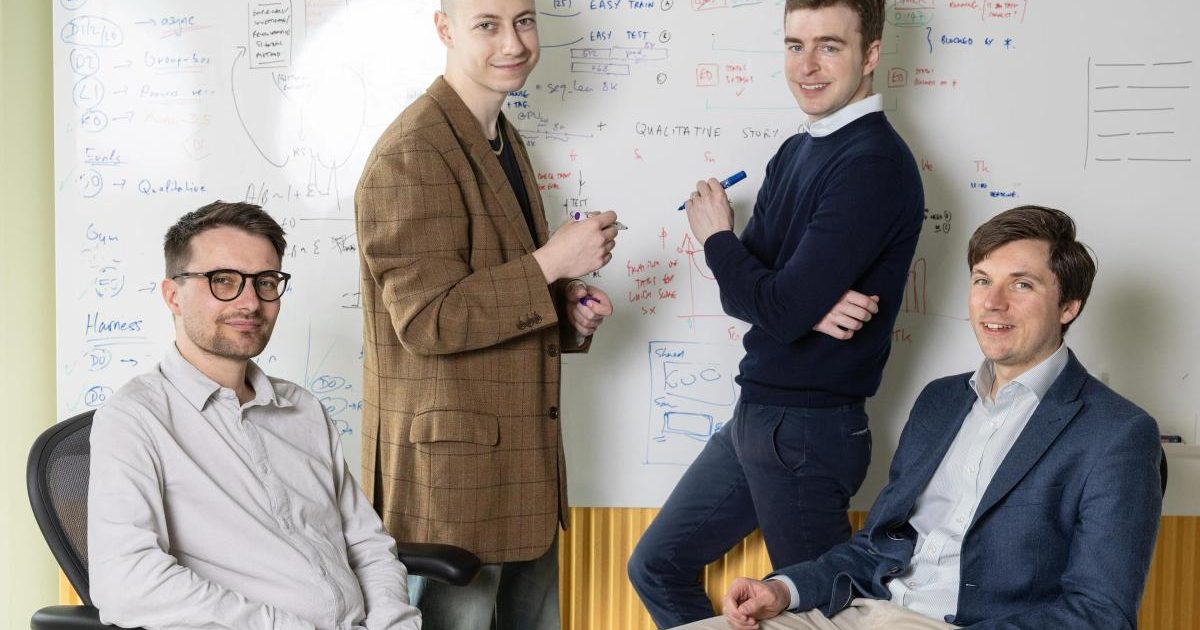
In an increasingly crowded landscape of startups founded by alumni of Google's DeepMind lab, a relatively small British company called Inherent has emerged to prove that model size is not the only measure of superiority. Just weeks after coming out of stealth mode with a fifty-million-dollar seed funding round, the company announced that its new AI agent, named "Faraday," outperformed larger and more famous models from OpenAI and Anthropic on a precise scientific task.
What Exactly Did "Faraday" Achieve?
The task involved independently reproducing the results of published scientific research, without the model being given the answer in advance. This task may seem simple compared to the company's larger ambition of building an AI capable of discovering new scientific knowledge, rather than merely verifying old results. But the company's co-founder and chief scientist, Edward Hughes, explains that reproducing research is a standard training exercise that human researchers themselves go through, as many PhD students begin their careers with this step.
Small Size, Superior Performance
The aspect worth catching investors' attention is the enormous size difference between the competing parties. While Anthropic's "Claude Opus 4.8" and OpenAI's "GPT-5.5" rely on massive frontier-level architectures, "Faraday" runs on a relatively small model called Qwen 3.6, whose parameter count does not exceed just 27 billion parameters. Parameters are generally an approximate indicator of a model's size and its training costs.
The company's success criterion was not limited to accuracy; it sought to have "Faraday" demonstrate what it calls "research taste," that is, the intuition that enables it to identify experiments worth carrying out and to design them well. Hughes stresses that the real goal was not merely to defeat competing systems, but the way the model was built and reached that result.
Reinforcement Learning as a Path to Building "Taste"
Teaching a machine an abstract skill like taste is extremely difficult, and this is where reinforcement learning comes into play—a training method that rewards the system for good outcomes rather than teaching it specific rules to follow. Instead of training its agents primarily on studying how to conduct science itself, Inherent is betting on this reward-based approach, believing it will generalize better toward its distant goal of building agents capable of contributing to multiple scientific fields.
A Philosophy Built on Focus and Collaboration
The company's vision was reflected in its technical decisions. Rather than developing its own software tool, it had "Faraday" use OpenAI's "GPT-5.5 Codex" tool, just as human scientists rely on available software rather than building everything themselves. The company also seeks to avoid building agents whose role is limited to flattering the user and saying what they want to hear, aspiring instead to a model of the ideal colleague who initiates curiosity and exploration, then presents its findings for discussion.
This collaborative approach extends to the company's own working style, as all twelve of its employees work in person from an office in London's "King's Cross" district, which, thanks to DeepMind's presence, has become one of the world's most prominent AI hubs.
Recruitment Challenges and Growth Ambitions
Hughes sees London as an ideal destination thanks to its density of talent, but he has joined the voices calling for an end to the practice of "gardening leave" common in the United Kingdom, which prevents a resigning employee from joining a competitor or founding a competing company for months after their resignation—a restriction that American researchers do not usually face. Inherent plans to expand its team to about 20 to 25 employees by the end of the year, with additional ambitions in the field of "world models."
- Seed funding of $50 million.
- A 27-billion-parameter model that outperformed much larger models.
- Reliance on reinforcement learning to build "research taste."
- Plans to expand the team and enter the field of world models.
Inherent's experience provides additional evidence that innovation in training engineering and objective design may rival the importance of scaling model size, opening the door to more diverse competition in the AI race.
✦ بقلم فريق دروب أيديا
DROPIDEA
We hope this article has added real value to you. At DROPIDEA, we always strive to deliver high-quality content that helps you grow and evolve in the digital space. Follow us for more useful articles and guides.
Tags
Admin
DROPIDEA
Latest Articles

The Indie Horror Film 'We're All Going to the World's Fair' and a Painful Coming of Age in a Digital World

Is Training AI on Copyrighted Books Legal? The Issue Is Complicated

Flock Surveillance Company Faces Mounting Criticism as Its CEO Calls for a «Middle Ground»

Study: A Third of New Web Pages Were Written by AI Since the Launch of ChatGPT

Strange Glitch Causes Grok Bot to Send Unintelligible Responses to Users
Related Articles
The Indie Horror Film 'We're All Going to the World's Fair' and a Painful Coming of Age in a Digital World
Is Training AI on Copyrighted Books Legal? The Issue Is Complicated