AI Terminology Glossary: Concepts You Should Know Today
 By Admin
Artificial intelligence is evolving at an accelerating pace, and with it emerges an entire glossary of terms describing how it works. Anyone attending a technical meeting or presentation these days will hear vocabulary like "large language models," "reinforcement learning," and "retrieval-augmented generation," along with new terms appearing weekly at a speed that makes even specialists feel the need to constantly keep up. In this article, we offer a clear explanation of the most important of these concepts for anyone building intelligent tools, investing in them, or simply wishing to stay current with the field.
Artificial General Intelligence (AGI)
The term "artificial general intelligence" is among the most ambiguous and controversial concepts. It generally refers to an artificial intelligence that surpasses the average human in performing most tasks. Sam Altman, CEO of OpenAI, described it as being like "a coworker with the abilities of an average human that you could hire." In contrast, some research bodies define it as autonomous systems that outperform humans in most economically valuable work, while Google's DeepMind lab views it as intelligence no less capable than a human in most cognitive tasks. The bottom line is that experts themselves have yet to agree on a unified definition.
AI Agent
An AI agent is a tool that uses artificial intelligence techniques to accomplish a series of tasks on your behalf, going beyond the capabilities of a traditional chatbot. It might submit expense reports, book tickets or a restaurant table, and even write and maintain code. While this field is still emerging and the term may carry different meanings for different people, the core idea is an autonomous system capable of drawing on multiple systems to execute complex, multi-step tasks.
API Endpoints
API endpoints can be imagined as "buttons" hidden behind software that other programs can press to perform specific tasks. Developers use these interfaces to build integrations between applications—such as one app pulling data from another, or an AI agent directly controlling external services without human intervention. As the capabilities of intelligent agents advance, they have become able to discover and use these endpoints on their own, opening up vast—and sometimes surprising—horizons in the field of automation.
Chain-of-Thought
The human brain answers simple questions without deep thinking, but sometimes needs intermediate steps to solve more complex problems. For example, if a farmer has chickens and cows totaling 40 heads and 120 feet, you might need a simple equation to arrive at the solution.
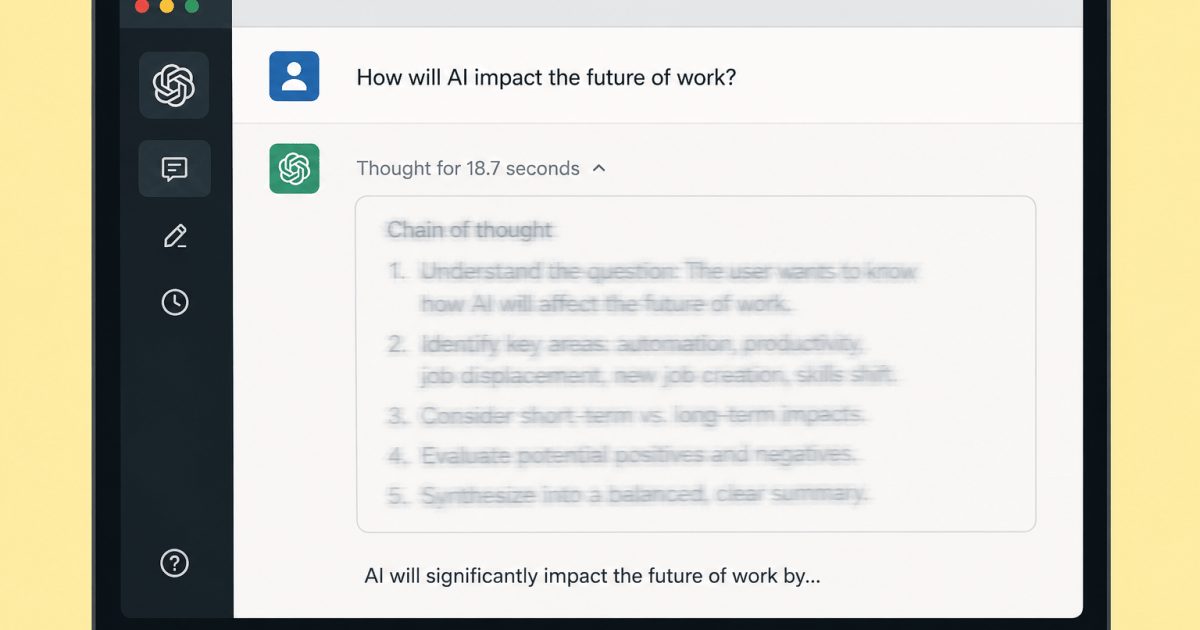
In the context of AI, chain-of-thought means that large language models break a problem down into smaller intermediate steps to improve the quality of the final result. It's true that this method takes longer, but it raises the likelihood of a correct answer, especially in logical and programming problems. Reasoning models are developed from traditional language models and then refined for chain-of-thought thanks to reinforcement learning.
Coding Agent
A coding agent is a specialized version of an AI agent geared toward software development. Instead of suggesting code for manual review, this agent can write, test, and debug code independently, handling the iterative trial-and-error work that typically consumes a developer's day. Among its most notable capabilities:
- Working across entire codebases and detecting errors within them.
- Running tests and providing fixes with limited human oversight.
- Completing tasks at high speed and without interruption.
But, as is the case with any intern, the human role remains essential for reviewing the final results.
Compute
The term "compute" generally refers to the vital computational power that enables AI models to be run, trained, and deployed. This power is the fuel that drives the entire sector, and the term is often used to refer to the hardware that provides it, such as graphics processing units (GPUs), central processing units (CPUs), tensor processing units (TPUs), and other infrastructure that forms the foundation of the modern AI industry.
Deep Learning
Deep learning is a branch of self-improving machine learning, in which algorithms are designed within the structure of a multi-layered artificial neural network inspired by the interconnection of neurons in the human brain. This structure enables more complex associations compared to simpler systems like linear models and decision trees.
Deep learning models are distinguished by their ability to identify important features in data on their own, without needing engineers to define them manually, and they also learn from their mistakes and improve their outputs through iteration and adjustment. However, they require enormous amounts of data (in the millions or more) and longer training time, which raises the cost of developing them.
The AI glossary remains a living document that continuously evolves as the field itself evolves, and understanding these fundamental terms is a necessary step for anyone who wants to keep pace with this technological revolution with awareness and insight.
✦ بقلم فريق دروب أيديا
DROPIDEA
We hope this article has added real value to you. At DROPIDEA, we always strive to deliver high-quality content that helps you grow and evolve in the digital space. Follow us for more useful articles and guides.
Tags
Admin
DROPIDEA
Latest Articles

Audi A2 E-tron: Audi's Most Affordable and Most Efficient EV

Arm Brings PC Gaming Technologies to Phones via the Mali G2-Ultra NX Processor

Bentley EXP 15: A Luxury Electric Vehicle with an Artificial V8 Engine Sound

Why Is Your Phone's Price Rising? A Memory Crisis Rocks the Tech Industry