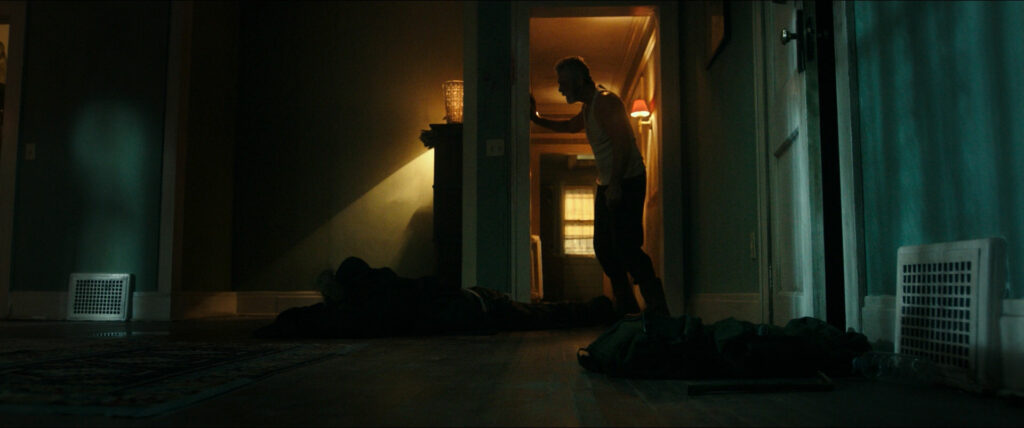
In today's article, we will talk about a problem that results when working and preparing lighting on a filming location. In today's article, we will explain the meaning of the term Room Tune further through a video that was previously published on our YouTube channel. We wish you an enjoyable viewing, then a peaceful reading. What is the term Room Tune? In short, the term Room Tune refers to the general lighting in the room, not the lighting that primarily illuminates the actor, such as Key Light and Fill Light. What is meant by the term Room Tune here is the lighting that is added to the shooting location, in order to raise the exposure values in secondary places in the scene, such as the background and the corners of rooms and corridors, in order to avoid any exposure problems in the image.
It does not fundamentally matter whether the lighting source is visible in the picture or not, nor does it matter the nature, intensity, and direction of the light as long as it fulfills the need and fills the space in the dark areas. Let us discuss the four examples below: In the first example from the movie The Equalizer (2014): Notice that there is lighting at the top of the corridor that illuminates the walls of the hall, whose walls form directing lines towards the actor sitting on the chair. If there was no soft lighting coming from the direction of the ceiling, the walls would have been completely black and without exposure limits, and those areas were the phrase Dead pixels devoid of detail. In the second example from the movie Seven (1995): We notice that there is lighting behind the actor that illuminates what is out of focus/focus, which helps to enrich the scene more with elements that vary in the amount of lighting in it. In the third example from the movie Due Date (2010): We notice that there is very light lighting coming from the ceiling and falling on the walls in the background (on both sides of the window) in order to highlight the features and details in those walls.
In the fourth example from the movie Zodiac (2007): We notice that there is a variety of lighting illuminating the background, some of which is coming from the left of the scene, simulating the lighting of a window, and some of which is coming from the ceiling towards the right of the frame to raise the exposure values in that spot in the scene. This article is a detailed article introducing the term Framework in cinematography. If you do not know what this term is, we highly recommend reading the basic article by clicking on the image below: We also highly recommend reviewing the previous article: Choosing the correct lighting angle – Upstage vs Downstage Remember this technique the next time you encounter exposure problems at the edges of your frame.
Until we meet in a new article, I would like to remind you that if you find any questions, you can send your inquiries through our accounts on the social networking sites, Facebook, Twitter,
Instagram. You can also subscribe to the Telegram channel to receive exclusive content and follow our latest news.
May you always be creative. Did you like the article? Share it with your friends..
DROPIDEA
We hope this article has added real value to you. At DROPIDEA, we always strive to deliver high-quality content that helps you grow and evolve in the digital space. Follow us for more useful articles and guides.

Admin
DROPIDEA
Latest Articles
Pangram Raises $9 Million to Detect AI-Generated Content

Encore AI تجمع 30 مليون دولار لبناء وكلاء ذكاء اصطناعي يتعلمون من مكالمات العملاء

Hint: The AI-Powered Home Management Assistant with Martha Stewart's Touch
Startup Runlayer Accuses Rippling of Stealing Its MCP Product Idea