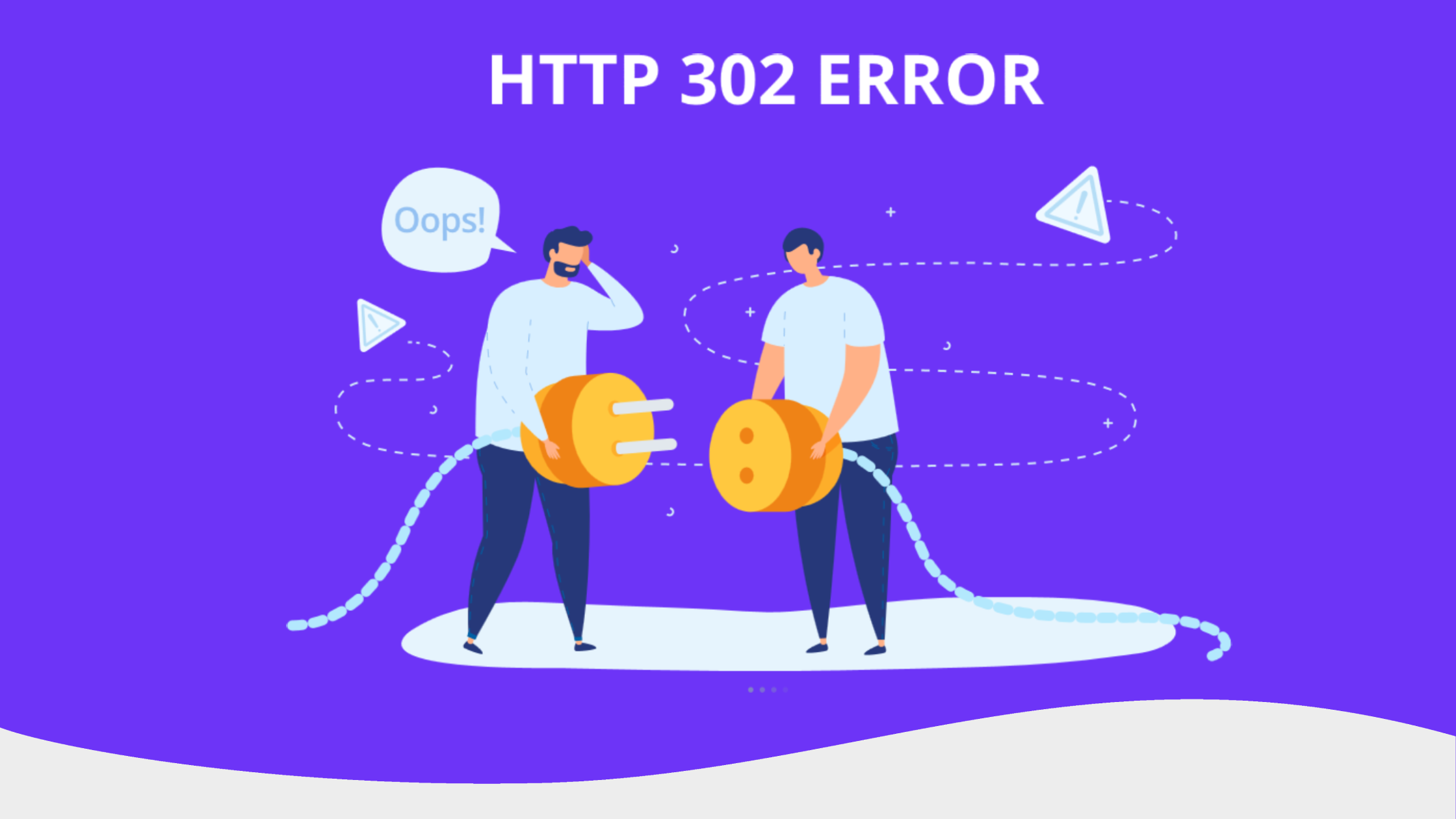
While you are managing a WordPress website, you may encounter the HTTP 302 error, so in this article we will clarify some concepts about this error, and present several methods that you can use to fix and get rid of the problem. In fact, HTTP 302 is an effective way to temporarily redirect website users to a different URL. However, if your site displays a 302 redirect by mistake and not because you set it up, this is an indication that there is a problem that needs to be solved on your site.
We will explain to you in the following paragraphs what the code or code 302 is in HTTP requests, what are the reasons for its appearance, when its appearance is evidence of an error on the site, and what are the steps to fix it in detail. So, continue reading the article to learn everything you need about HTTP 302 errors. Contents of the article What does HTTP response code 302 mean Ways to fix the HTTP 302 error on a WordPress site 1- Disable all WordPress plugins 2- Check the WordPress link settings 3- Check the server settings Apache server NGINX 4- Contact the support team for hosting your site. What does the HTTP 302 response code mean? When you visit any website on the Internet through the browser, the browser sends a set of HTTP requests to the requested site server, which in turn responds to these requests, and each response has its own HTTP code. All codes that begin with the number 3 are codes that indicate the presence of a redirection process, and the code 302 indicates that this redirection process is temporary, that is, when you visit the site domain.com, you will be redirected, for example, to the site dev.domain.com temporarily. HTTP 302 differs from HTTP 301 in that the transfer process in the event of a 301 redirect means the permanent transfer of 302 URLs and is used when transferring pages or transferring sites permanently, while a 302 redirect is a process that takes place temporarily as a result of an emergency, but it continues unless you cancel its setting manually after the temporary period expires.
For example, if you intend to create a new page on your site but have not done so yet, and you want to temporarily move visitors to a page titled (under construction) until the page is finished, then use a 302 redirect. But what does it mean that this redirect is temporary, and when does this code become an error that must be fixed? Temporary directives are typically used by default on all pages or domains that need maintenance or changes in design or functionality.
Since 302 redirection is a temporary transfer of a URL, it is preferable that the duration of the transfer using it not exceed one to two weeks. During this stage, the site owner or developer may not want site visitors to be able to see what changes are taking place on the site, but at the same time he does not want his site to lose its ranking in search engines. So this redirection only applies to real visitors and not to search engine spiders or bots.
But a 302 redirect becomes an error in the following cases: When it is caused by a change within the site but you did not intend this redirect. When redirected to a wrong address that does not exist. When you get stuck in a loop of HTTP 302 redirect requests that prevent site visitors from accessing content on either the old or temporary domain.
The last case is the only case in which an explicit error message appears within the browser, as the following image shows the error message within the Google Chrome browser. In the Firefox browser, it is as follows.
Ways to fix HTTP 302 error on a WordPress website
This error on WordPress sites can result from several reasons, and based on them, you can choose the appropriate repair method for you. This could be a plugin update, an incompatibility between plugins, a .htaccess file settings error if you are using an Apache server, or an nginx.conf file settings error if you are using an NGINX server. Therefore, you must first track the recent changes you made to the site that preceded your discovery of this error, such as installing a new plugin, installing a new template on your site, or modifying any files belonging to the WordPress platform.
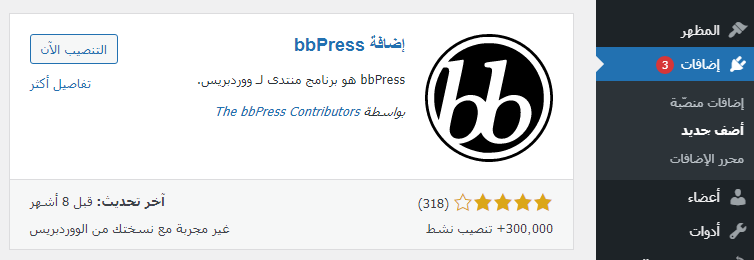
1- Disable all WordPress plugins. It is possible that one of the plugins that you recently installed, or one of the updates that one of the plugins received, is the cause of this error. To be sure, you must disable all plugins on your site, and revisit the link in which the HTTP 302 error appears. Go to Add-ons < إضافات منصبة < ثم اختر جميع الإضافات وعطلها كما هو موضح في الصورة التالية.
Note: If you cannot access the control panel
The site is due to redirection resulting from this error. Then you can access your site files through the file manager in the cPanel hosting control panel, or through the FTP protocol, where you can easily disable plugins by changing the name of the plugins folder to another name such as plugins_old. If the HTTP 302 error disappears, this means that one of the add-ons is the cause of the problem. To determine the specific add-on, you must reactivate the add-ons one by one until the error occurs again to find out which add-on is responsible for this error. When you discover it, you must replace it or find a solution to the problem by contacting the add-on developer.
2- Check the WordPress link settings. One of the common reasons for the HTTP 302 error to appear in WordPress is the incorrect setting of the WordPress title and site address links. To verify that the linking process is set up correctly, do the following. 1- Within the WordPress control panel, go to the Settings tab < عام من القائمة الفرعية. 2-تحقق من كتابة حقلي عنوان ووردبريس URL، وعنوان الموقع URL بالشكل الصحيح كما هو موضح في الصورة المتحركة التالية: 3-التحقق من إعدادات الخادم يمكن أن يظهر هذا الخطأ بسبب ضبط خاطئ لإعدادات الخادم، وفيما يلي سنستعرض لك طريقة حل الخطأ HTTP 302 على أشهر أنواع الخوادم وهما خادم Apache وخادم NGINX (ويمكن بأسلوب مشابه تطبيق الخطوات على أي خادم آخر).
Apache Server You can control the Apache server through the settings within the . htaccess, so you should review the content of this file and do the following steps. 1- You have to open a file.
htaccess located on the server under the site's main folder (this path varies depending on the type of hosting and control panel used). If you are using cPanel, you will find this file in the public_html folder for the main site. As for other sites hosted within the same hosting, you will find this file within folders with the name of the desired site inside or outside the public_html folder.
2- Look for the RewriteXXX directives belonging to the mod_rewrite module within the Apache server. For example, the RewriteCond includes the link for which you want to direct traffic to another link, using the RewriteRule directive that is associated with one or more RewriteCond directives. The following example is a simple example of how the above two directives can be used together. Traffic to example.com is temporarily redirected to temporary-example.coM with the following code: RewriteEngine on RewriteCond %{HTTP_HOST} ^example.com$ RewriteRule ^(.*)$ HTTP://www.temporary-example.com/$1 Notice the last part of the RewriteRule directive in the previous example that says the response code should be 302 to tell the browser that this redirect is temporary. 3- You must now reset the directives again within the .htaccess file, and for this you must compare with the default values that are usually found within this file, which are as follows.
# BEGIN WordPress RewriteEngine On RewriteBase/ RewriteRule ^index.php$ – RewriteCond %{REQUEST_FILENAME} !-f RewriteCond %{REQUEST_FILENAME} !-d RewriteRule. /index.php # END WordPress If you find any directive different from the previous example, you can put a # sign before it to disable it, then restart the server and then check whether the problem is solved or not. NGINX Server You can control the NGINX server through the settings within the nginx.conf file, so you must review its content and perform the following steps.
1- You must open the nginx.conf file, which is usually located under one of the following directories: /usr/local/nginx/conf, /etc/nginx, or /usr/local/etc/nginx. 2- Look for link directives. The following example is a set of directives that temporarily redirect visitors from the link abc.com to temporary-abc.com. server { listen 80; listen 443 ssl; server_name www.abc.com; rewrite ^/$ http://www.temporary-abc.com redirect; } The rewrite directives within the nginx server are equivalent to the RewriteRule and RewriteCond directives within the Apache server. 3- Get rid of the rewrite directives by using the # sign before them, then restart the server and check whether this step solved the problem or not. If the problem was solved, its cause is one of the previous directives.
4- Contact the support team for your hosting. If you have tried all the previous methods that we mentioned in the article, but the problem still exists on your site, then we advise you to contact the support team for your hosting. Because knowing the actual cause of this error and fixing it in some cases requires great technical knowledge and experience. So it is better to get help from your hosting experts.
Conclusion In today's article, we explained in detail HTTP 302 response codes, which are usually very normal codes, and we showed that they are a simple way to temporarily redirect your site visitors to another site, but you should only use them when the page resources requested by visitors are not available. However, if your site returns a 302 code by mistake, or causes a loop of redirects, then you must fix the problem as quickly as possible after knowing its actual source, whether it comes from the server or from WordPress, otherwise this will negatively affect your site.
DROPIDEA
We hope this article has added real value to you. At DROPIDEA, we always strive to deliver high-quality content that helps you grow and evolve in the digital space. Follow us for more useful articles and guides.

Admin
DROPIDEA
Latest Articles

Pangram Raises $9 Million to Detect AI-Generated Content

Encore AI تجمع 30 مليون دولار لبناء وكلاء ذكاء اصطناعي يتعلمون من مكالمات العملاء

Hint: The AI-Powered Home Management Assistant with Martha Stewart's Touch

Startup Runlayer Accuses Rippling of Stealing Its MCP Product Idea