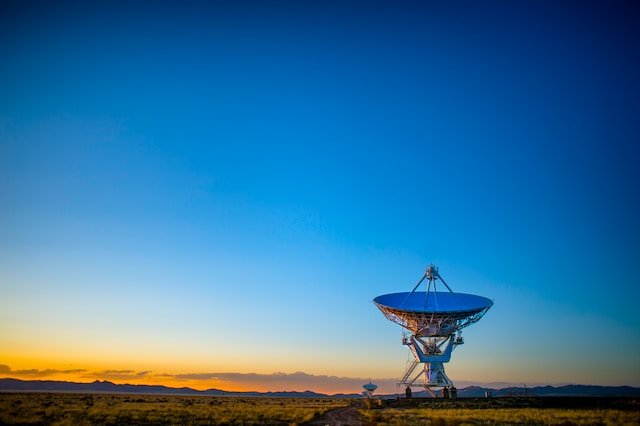
A radio telescope is a device used to receive and analyze radio signals coming from outer space. The radio telescope is one of the modern astronomical tools used to study and understand the universe. A radio telescope is different from an optical telescope, which is used to analyze light signals.
Instead of using lenses and mirrors to collect light, a radio telescope uses metal antennas to receive radio signals. A radio telescope works by converting radio signals into electrical signals that can be analyzed and studied. A radio telescope can observe radio signals emitted by planets, stars, galaxies, and other astronomical objects.
Radio telescopes are used in astronomical research for various purposes, such as studying star explosions, black holes, and distant galaxies. These studies can contribute to increasing our knowledge and understanding of the universe. Thanks to technological advances, it has become possible to design and build large, highly efficient radio telescopes.
Using these telescopes, scientists can explore the depths of the universe and reveal new secrets related to its formation and evolution. Radio telescopes are essential tools for astronomers to study celestial phenomena that cannot be seen with visible light, such as pulsars, quasars, and cosmic microwave background radiation. By analyzing data collected using radio telescopes, scientists can examine the structure and properties of distant galaxies, star-forming regions, and the interstellar medium.
Definition of a radio telescope: A radio telescope consists of a large parabolic or dish-shaped antenna that collects radio waves from space. It includes a receiver and amplifier to boost the signal, and a recorder to preserve the data for analysis.
Unlike a typical telescope, which creates an image by focusing light, a radio telescope collects radio waves and uses a computer to translate the signals into images or data that scientists can study. Components and Functions: The basic elements of a radio telescope include: – Dish: Also known as a reflector, the dish focuses incoming radio waves onto the receiver.
– Receiver: This component picks up radio waves and converts them into electrical signals. – Amplifier: The amplifier boosts weak signals so that data can be recorded and analyzed. – Recorder: Data storage systems, often computers, store the signal for later processing.
Importance in Astronomy: Radio telescopes have greatly expanded our understanding of the universe. They complement optical telescopes by capturing different types of information and are vital for observing objects that are very faint or obscured by interstellar dust.
These telescopes can also operate day and night and through clouds, giving them an advantage over their optical counterparts. Insights and future of radio astronomy The field of radio astronomy is advancing rapidly, with the emergence of new technologies leading to the construction of larger and more sensitive telescopes capable of detecting fainter and more distant sources.
Radio telescope arrays, such as the Very Large Array (VLA) or the upcoming Square Kilometer Array (SKA), allow higher resolution imaging by combining signals from multiple antennas spread over vast distances. One of the extraordinary contributions of radio astronomy was the discovery of the cosmic microwave background, which provided strong evidence for the Big Bang theory and has implications for cosmology and understanding the origins of the universe. As technology advances, future radio telescopes will delve deeper into the unexplored universe, exploring the mechanisms of galaxy evolution, the nature of dark matter, and the possibility of extraterrestrial life.
Questions and Answers (FAQ) What can radio telescopes detect? Radio telescopes can detect a wide range of astronomical phenomena, including stars, galaxies, black holes, nebulae, and other celestial bodies that emit radio waves.
They are particularly useful for studying objects that are not visible at other wavelengths of light. How do radio telescopes differ from optical telescopes? Radio telescopes detect radio frequencies, while optical telescopes detect visible light.
Radio telescopes have large dishes to collect weak radio waves, unlike lenses or mirrors in optical telescopes, and they can also operate in inclement weather and during the day. Why are some radio telescopes so large? The size of a radio telescope dish is directly related to its sensitivity and resolution.
Larger dishes can collect more radio waves, resulting in stronger signals and finer details in observations. Can radio telescopes be used to communicate with spacecraft? Yes, radio telescopes can often be used as part of deep space communications networks to send and receive signals to and from spacecraft, including those beyond Earth orbit.
For more detailed information about radio telescopes and their role in modern astronomy, reliable resources can be found on the websites of major observatories and space agencies such as NASA (www.nasa.gov) and the European Southern Observatory (www.eso.org). As radio astronomy continues to develop, discoveries made with the aid of radio telescopes will undoubtedly continue to push the boundaries of our cosmic knowledge, providing us with a deeper appreciation and understanding of the vast universe in which we live.
#radiotelescope #astronomy #universe
DROPIDEA
We hope this article has added real value to you. At DROPIDEA, we always strive to deliver high-quality content that helps you grow and evolve in the digital space. Follow us for more useful articles and guides.

Admin
DROPIDEA
Latest Articles

Nscale Acquires Anyscale for $1.65 Billion to Expand Its Dominance in AI Infrastructure

How Is AI Accelerating Meta's New App Launches?

Okta Acquires Security Firm Permiso for Around $200 Million

Microsoft Gains $3.2 Billion from Its Investment in Anthropic