What is the difference between the terms T-STOP and F-STOP?
 By Admin
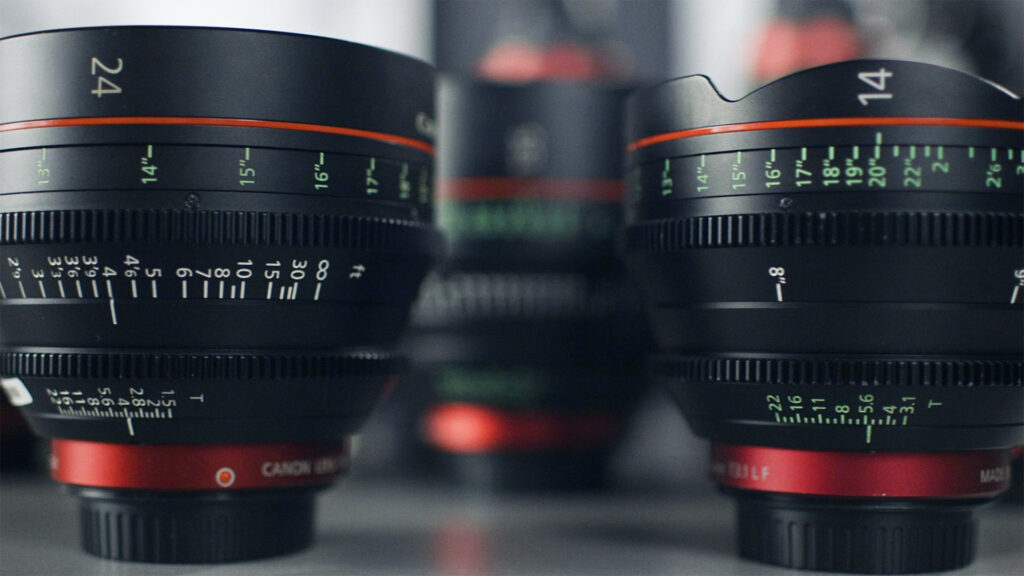
If you started moving from photography to the world of videography, you may have heard the term T-stop. In this article, we learn together about the difference between the terms T-STOP and F-STOP and their effect on the image in detail. We spoke previously, in a special article, about the meaning of the term F-stop, and we spoke about the importance of understanding this term in order to reach a sound concept when talking about exposure and lens aperture, but everything mentioned above was specialized in the photographic perspective of the lenses, and when talking about shooting video professionally, such as films, documentaries, etc., we will notice, as we move from photographic lenses to video lenses, the presence of a completely new mark on the body of the lens. There is no longer an F value for the lens aperture, but there is a new symbol, which is T.
In today's article, we learn together about the meaning of T-Stop and the fundamental and important difference between it and the term F-stop in lenses. To recall some information... In the article What is the term F-stop, we talked in detail about the relationship of two important elements in determining the amount of light that enters from the lens and reaches the sensor. At that time, the talk was (and I will be brief here out of necessity) that the term F-Stop is a relationship to measure the amount of light that the lens allows to pass through it in comparison with the focal length of the lens and the diameter of its aperture.
So the numbers on the lens are the value of a certain amount of light, but that does not necessarily mean that that value is the same that reaches the camera sensor. This is normal since these lenses are intended for photography, but what about the term T-Stop? What is the term T-Stop? When working accurately and professionally with lenses and lighting for video work, it is important to know precisely the amount of light that reaches the sensor. How much light enters and exits the lens to reach the sensor?
We know that glass in its natural state allows light to pass through it, but the amount of light decreases the more layers of glass there are, and when there is a need to accurately know the amount of light coming out of the lens, a new term called T-Stop had to be adopted. T-Stop is a measure of the amount of light that exits the lens and reaches the camera sensor. The letter T stands for the term Transmission. How much light is transmitted through the lens to reach the camera sensor? Therefore, in order to accurately reach the correct exposure value that reaches the sensor from the lens, I found an equation to find the T-Stop value for the light passing through any lens, which is as follows: Perhaps you may be wondering where can I get these numbers and do I have to do the math in order to ensure I shoot correctly?
The short answer is no! But it is very important for you to know the difference between the two terms mentioned above. Both are used to determine the amount of lighting, but under different conditions. What are the most important differences between the term T-STOP and the term F-STOP?
Suppose from the above equation that we have a lens and assume the value of its focal length is 50mm, we set the value of the lens aperture to f/2, and the lens passes the light towards the sensor at a rate of only 75%, then the value will be Lens T-Stop: t/2.3. Note the difference: t/2.3 and f/2. Perhaps during our presentation of the numbers above we noticed that the difference is slight in exposure, but this difference is radical when talking about video shooting. Both values are similar in their effect when changing the values on the amount of exposure. The higher the T-Stop value, the darker the shot will become, and vice versa, just as it is in the concept of the lens aperture normally.
Here, many people make a mistake when they consider that the value of the T-stop is the same as the F-stop, meaning that f/2 is not equal to t/2, because then we will find that the shot photographed at t/2 is less illuminated than the one photographed at f/2, and this is very normal according to the above equation and the example we presented. Hence the importance of this term in video shooting! Imagine with me, dear reader, that you are on the set, photographing a scene, and you want to change the lens size to a wider or narrower lens than the current one. Remember that you cannot modify the camera settings such as shutter speed, ISO, and number of frames. You wanted the same exposure value in both shots, without changing the T-stop value.
For this to happen technically, you must use two lenses with the same optical conductivity value that we talked about above, and with one lens aperture. Then you will find that swapping the old and new lens on the camera will not affect the amount of exposure as long as the settings are the same and the t/stop value is the same, and this is necessary to ensure a smooth transition between the lens measurements. But if we use photographic lenses for this matter, we will face the problem that they are not uniform in their optical conductivity value. For this reason, we conclude that if you are working on a photographic project, you do not have to pay much attention to the T-Stop value of the lenses that you use, but if you are working on a video project, you should pay attention to this issue seriously, especially if you are using a variety of lenses from different brands.
I hope that this article is sufficiently comprehensive regarding the difference between the terms T-STOP and F-STOP. I would like to remind you that if you find any questions, you can send your inquiries by clicking on Contact Us, and you can also follow us through our account at
For more exclusive content. May you always be creative.
Did you like the article?
Share it with your friends..
DROPIDEA
We hope this article has added real value to you. At DROPIDEA, we always strive to deliver high-quality content that helps you grow and evolve in the digital space. Follow us for more useful articles and guides.
Admin
DROPIDEA
Latest Articles

Nscale Acquires Anyscale for $1.65 Billion to Expand Its Dominance in AI Infrastructure

How Is AI Accelerating Meta's New App Launches?

Okta Acquires Security Firm Permiso for Around $200 Million

Microsoft Gains $3.2 Billion from Its Investment in Anthropic