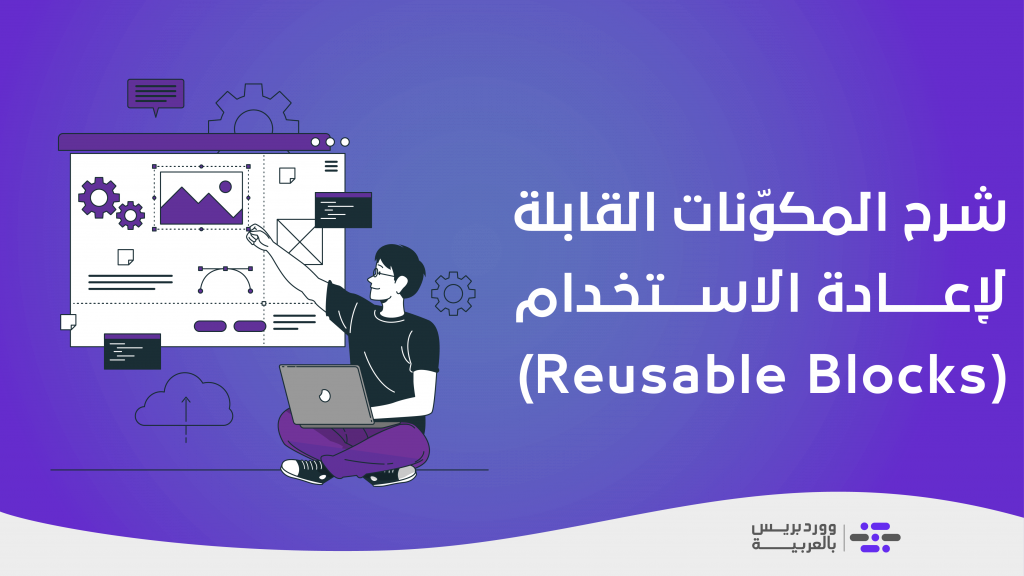
Reusable Blocks are one of the important features of the WordPress block editor (Gutenberg). It helps you create ready-made designs and formats that can be used anywhere (articles, pages, other WordPress sites). If you have formats or designs that you want to use repeatedly, for example, certain buttons, text, or an image, or you want to put a profile of the author, for example, at the end of the article, and many others.
Using Reusable Blocks, you can create this design or layout just once, and then add it anywhere with great ease. Reusable components are one of the hidden features in the new WordPress editor, but they save you a lot of time and work, and you do not need any technical experience to deal with them. In this article, we will talk about how to use Reusable Blocks to create a specific format or create a group of components together.
We will also learn about the features it offers and how to export it and use it on other WordPress sites. What are Reusable Blocks? A reusable component allows you to create a specific layout or design of a regular component from the rest of the content, whether it contains a single element or a group of elements, and save it as a reusable component; Thus, you design it once and use it more than once on any page of your site.
Suppose, for example, that you have a specific text that you want to repeat on all of your pages, or that you want to place an image with a button next to it, and you want to repeat it on all of your pages or articles. The same goes for social media sharing and other content you want to repeat more than once. Read also: Explanation of the Gutenburg component editor for adding articles and pages The benefits of using reusable components If you are the owner of a website or blog, today you must take advantage of this important feature to save time and save effort.
There are many things on your site that you will need to repeat more than once, whether on your pages or articles. One of the most frequently repeated things is the beginning and end of articles, where you need, for example, to add social media buttons, add a glimpse of the author, comments, and other things. With Reusable Blocks, you can design this just once. The same applies to creating tables, which is difficult to design; You will no longer need to design it more than once.
There are also many elements that you can save once, such as surveys, forms, and tests, and then use them and change the content only. Simply put, you design only once, then save this design and use it where you want, and then modify the content if you want.
How to use the reusable component enables you to
Through the component editor for WordPress, you can create a reusable component, modify it, and export or import components. It also provides you with a page to manage and control reusable components. We will create some examples and explain them gradually throughout the article, so that you can learn step by step how to create a reusable component, how to use it in other articles and pages, as well as how to delete a component and how to control and manage components. 1.
Create a new reusable component. For example: We want to create a reusable component, which is a paragraph and a group of buttons for social media accounts, so that we can use this component in all articles. First, we will create a new paragraph, by clicking on the (+) sign, and then adding the required component, let it be a paragraph that will be the paragraph we want, as follows. Then we will create buttons for the blog or website’s social media networks. You must press the (+) sign, then choose Button Group, to add a group of buttons. After that, you can add the number of buttons you want, by pressing (+). After that, you can change the name of the buttons by selecting and changing the text. You can also control the buttons, by selecting the button you want to design, pressing the three dots, and choosing Show more settings.
You will see a long list of options that will help you design the button, such as changing the color, controlling the text or size, adding effects, or many other options. Thus, we have a component that encourages the visitor to share content across social media platforms, and we want to use this component as a ready-made form that can be called up on any page or article with one click, instead of setting it up again every time. We will do this by selecting the desired component content, then clicking on the three dots, then adding reusable components, after which the reusable component will be created.
You can change the name of the component, by clicking on the three-dot menu, and choosing Show more settings, where you can change the name (we will call it Social Accounts) from here and click on Publish to save the new name. Now we have a reusable component, which is a paragraph and a group of buttons, and with just one click, we can add this component to other pages or articles, or you can also export it for use on other sites. 2. Call the component that can be used on a new page. Now we can easily call this component by opening a new article, by going to Articles
DROPIDEA
We hope this article has added real value to you. At DROPIDEA, we always strive to deliver high-quality content that helps you grow and evolve in the digital space. Follow us for more useful articles and guides.

Admin
DROPIDEA
Latest Articles

Nscale Acquires Anyscale for $1.65 Billion to Expand Its Dominance in AI Infrastructure

How Is AI Accelerating Meta's New App Launches?

Okta Acquires Security Firm Permiso for Around $200 Million

Microsoft Gains $3.2 Billion from Its Investment in Anthropic