Methods and types of lighting: The Softhub Lighting
 By Admin
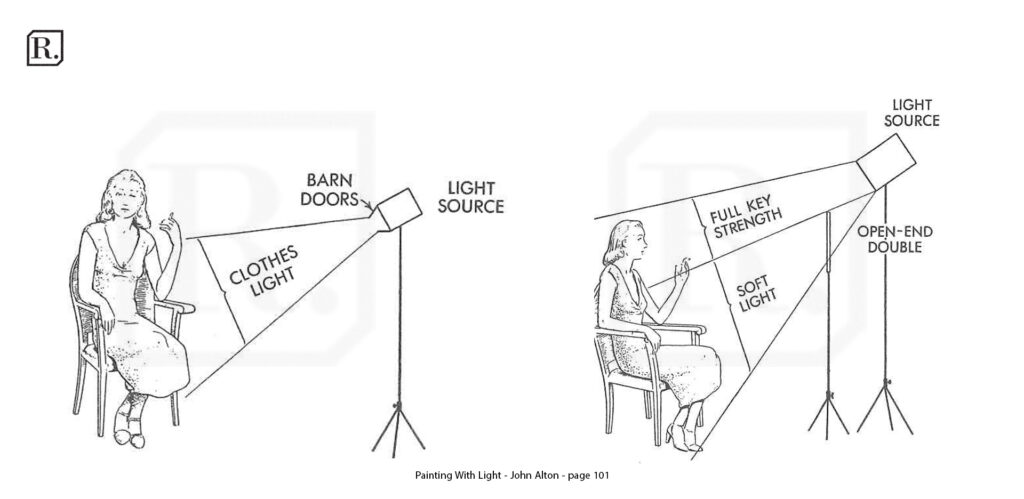
In this detailed article, we will talk about a lighting technology called The Softhub. In this article, we will talk about the importance of this technology and why it is widely used in cinematic works, how we can use it, and what is the mechanism for controlling it. The Reverse Softhub In the past period, I was reviewing the book Painting With Light by filmmaker John Alton, which we previously talked about in the article The Ten Important Books for Filmmakers. While I was reading the book, specifically on page 101, the writer talks about a lighting technique that was used in the early days of cinema (and still is today). That method was truly eye-catching, and it states the following form: The idea used states that the main light is separated into two parts, which differ from each other in intensity, by passing a part From the light through a panel called Open End Frame, which is a silk mesh based on breaking the intensity of the light by a certain percentage (in the example above, the panel reduced the light by half). Now the idea that was presented in the book is to place this panel to separate the light used into two parts, the primary section, which is the general light, Key Light, and the secondary section, which we can call clothing lighting, so that the primary lighting is twice the lighting shed on the clothing. In this way, we have used only one light to create two different lighting on the item. Given what developments have reached in the world of filmmaking, filmmakers use a lighting pattern adapted from the previous mechanism. Let us assume together that the previous mechanism is the first version of lighting separation techniques and we can call it the reverse Softhub, and what we are talking about today will be the advanced version of it.
What is The Softhub technology in lighting? The Softhub technology refers to the use of two separate light sources under the name Key Light. One of these lighting is characterized by its softness and formation of soft shadows and is responsible for illuminating the actor’s face, while the other light is sharper without any distractions, which forms a strong and sharp light on the actor’s body. How do filmmakers use Softhub technology?
Is it enough to use two lighting sources very spontaneously?
To reach the desired result? Of course not. The matter requires more care and attention, and this is exactly what we will talk about today. First, let us talk about the types of lighting that can be used in such work. Since we are talking primarily about simulating sunlight, it is natural to use HMI lighting. Specifically, our options are limited to the following lighting: Arri HMI M8 Arri HMI M18 Arri HMI M40 ArriMax 18/12 As we know, these lighting cannot be reduced in intensity to match the camera settings, as they are completely different from the LED lighting that is used in small studios. These lightings are characterized by high illumination power, so they are used to simulate sunlight. By using this type of lighting, we can turn the shooting location at night into a morning or daytime atmosphere. Therefore, this type of lighting is characterized by strength, quality, and accuracy in the light temperature scale, since they are all fixed around the value of 5600 Kelvin, which is the temperature value of daylight, with lighting to high CRI color rendering values.
So how can we adjust the camera settings according to our lighting values? In other words, if we set the camera to the first light, the second light will have a higher intensity and strength, and there will be a greater difference between the exposure and contrast ratios between them, and this may cause a rise in the exposure ratios in the areas of the second light, whereas if we set it to the second, brighter light, we will face another problem, which is the intense need for lighting throughout the entire shooting location, since we have closed the lens aperture greatly.
What is the solution then?
I talked in detail about the mechanism for adjusting the camera settings, from lens aperture and ASA value to achieve correct exposure and not exceed the native ISO value. You can continue reading the content with pictures and explanations through the blog account on the Patreon website by clicking on the image below: In conclusion, I would like to remind you that if you find any questions, you can send them your inquiries by clicking on Contact Us, and you can also follow us through our Instagram account for more exclusive content. May you always be creative.
Did you like the article?
Share it with your friends..
DROPIDEA
We hope this article has added real value to you. At DROPIDEA, we always strive to deliver high-quality content that helps you grow and evolve in the digital space. Follow us for more useful articles and guides.
Admin
DROPIDEA
Latest Articles
Nscale Acquires Anyscale for $1.65 Billion to Expand Its Dominance in AI Infrastructure

How Is AI Accelerating Meta's New App Launches?
Okta Acquires Security Firm Permiso for Around $200 Million

Microsoft Gains $3.2 Billion from Its Investment in Anthropic

Zuckerberg: Billions of People Will Have AI Assistants Within Five Years
Related Articles
ASUS ROG Flow Z13 (2025) available: Everything you could dream of in a gaming tablet.
Pay attention: 10 symptoms that confirm damage to the hard disk and the need for your quick intervention!
