Snapchat influencers: an analytical study of Saudi content
 By Admin
The number of Snapchat users in the Kingdom, according to reports issued by Hootsuite, has reached more than 13.65 million users, i.e. second place in the world. Saudis are the Arab people who use the application the most, and second in the world. Snapchat is considered one of the most important social media applications, especially in the Kingdom of Saudi Arabia. According to a study conducted by the British research company Global Web Index, the Saudis were the most Arab people who used the application, and they ranked second in the world after the Irish. According to reports issued by Hootsuite and We Are Social during the first quarter of 2019, the number of Snapchat users in the Kingdom reached 13.65 million people, of whom females represent 51%.
One of the factors that made Snapchat gain this status is its reliance primarily on photos and video clips, which have a stronger impact on recipients compared to the written word, in addition to being easier to convey the media message. Due to the value of “Snapchat” as a major social media network for Saudi citizens, the phenomenon of “influencers” or “Snapchat celebrities” was formed, a term given to people who have huge numbers of followers of their accounts on the application, which made them a target for commercial institutions and advertisers, to use them as advertising tools to advertise their products, and to benefit from the broad base of their followers, which ensures achieving a high viewership rate. These transformations resulted in a state of chaos as a result of the overlap that occurred between personal content and popular advertising content in the application, and a significant segment of Saudi society began to view Snapchat celebrities and the content provided by them with great suspicion and suspicion, which imposed the importance of studying the content provided by these influencers, especially women, because they constitute the largest percentage of its users in the Kingdom, according to the Hootsuite report for the year 2019.
The study presents below the results of analyzing the content of Snapchat clips by Saudi female influencers, according to the following variables: Contents of the topic Toggle 1- Nature of content: 2- Content framework: 3- Topic of content: 4- Objective of content: 5- Target audience: 6- Credibility of content: Conclusion.. 1- Nature of content: At the top of the types of content broadcast by Snapchat influencers in the Kingdom was “commodity marketing” at a rate of 51%. In second place was “personal content” with a rate of 27.6%, in third place was “marketing of services” with a rate of 13.1%, and in fourth and final place was “an idea or issue for discussion” with a rate of 8.3%. This result indicates that advertising content represents the main content for influencers on Snapchat in the Kingdom.
They got lost in the personal content that includes personal matters related to the diaries and movements of some influencers, and their relationships with their followers, friends, and families, as they deliberately mentioned the great interaction on their content by the followers, and also displayed the discounts that some influencers offer exclusively to their followers, in addition to talking with female visitors to some commercial establishments, and they confirm that the reason for their visit is It is the influencer’s propaganda for herself, and the influencer aims to promote herself and show the extent of her ability to influence, with the aim of attracting the owners of institutions and shops to seek help from her in their advertising campaigns. Most of them also resort to displaying their personal content with the aim of creating a kind of familiarity with their followers, which provides a degree of closeness and credibility that facilitates the process of influence and persuasion, by imitating the influencers’ followers with the consumer or service products they offer. As for marketing services, most of the services that the influencers addressed were job advertisements, while the discussion of ideas and issues topped the list of content that the influencers addressed, and the topic of unemployed Saudi youth came to the forefront of these issues presented.
Despite the importance of discussing societal issues and intellectual debate because it is beneficial to society, it ranked last in the list of content provided by influencers, which reveals that most influencers are not preoccupied with serving the community and providing constructive and useful content, as much as they are preoccupied with achieving financial profit through marketing and advertising various goods. 2- Content frame: The “commercial” frame came at the top of the content frames provided by the “Snapchat” influencers in the study sample with a rate of 42.8%, followed by the “social” frame with a rate of 26.2%, then the “welcoming” frame in third place with a rate of 11.7%, the “religious” frame in fourth place with a rate of 6.9%, and the “humanitarian” frame in fifth place with a rate 4.1%, then the “technical” framework came in sixth place with a percentage of 3.4%, then the “educational” framework ranked seventh with a percentage of 2.1%, and both the “sports” and “medical” framework had a small percentage of 1.4% for each equally. It is noted that the commercial advertising framework aimed at financial profit appeared at the forefront of the frameworks of the content provided, as it was the most dominant in the content of influencers in the “Snapchat” application.
It was striking that the topics that were characterized by a social nature did not primarily address social issues or matters specific to Saudi society, but rather focused on the social life of the influencers, such as their family relationships and their interaction with followers. As for the “welcome frame,” it contained a variety of different contents, such as welcome messages, and publishing personal and landscape photos. As for the religious framework, its topics were dominated by preaching and religious supplications, and it was noted that the majority of these supplications were placed as pictures at the beginning or at the end of the day without commenting on it, and sometimes there was a contradiction between this framework and the contents presented in the snaps, which in part reflected some aspects of extravagance and extravagance, which are inconsistent with the teachings of the Islamic religion.
The humanitarian aspect dealt with some projects sponsored by charitable organizations, in addition to presenting some individual charitable works. It was noted that this framework was limited to one of the influencers only, and its topics were not distributed among more than one influential person, meaning that it was linked to the person of the influencer. The artistic framework was also limited to some influencers publishing musical pieces without commenting on them, to give their diaries an aesthetic appearance. Their content was devoid of “political,” “economic,” and “cultural” topics, which makes it clear that the latter categories did not capture the attention of influencers, as serious issues do not occupy a place on their list of priorities.
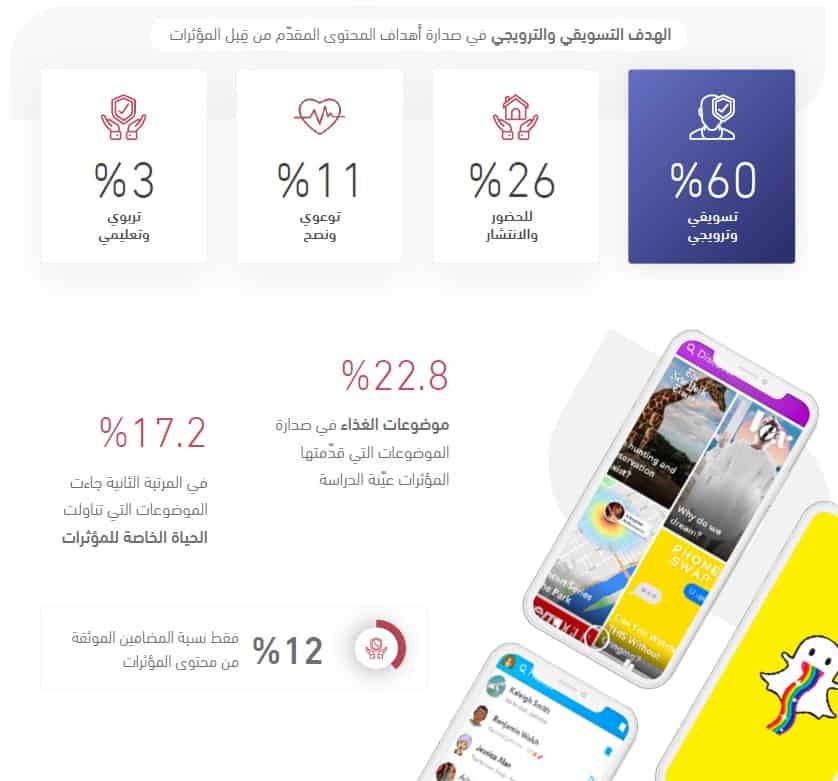
3- Topic content: Food topics came at the top of the topics presented by the influencers in the study sample with a rate of 22.8%, and in second place came the topics that dealt with the private lives of the influencers with a rate of 17.2%, then fashion and fashion came in third place with a rate of 10.4%, then household appliances came in fourth place with a rate of 9%, then jobs in fifth place with a rate of 7.6%, then makeup and care products, and entertainment materials with a rate of 6.9% equally for each. Of these, then providing more than one product belonging to more than one field at the same time at a rate of 6.2%, followed by products of worship at a rate of 5.5%, then health products at a rate of 4%, then the field of tourism and travel at a rate of 3.5%. These results reveal that food is the most advertised product, especially since food commodities cannot be dispensed with by any individual, and they constitute the largest portion of consumer behavior, and because influencers direct a large portion of their content to women, the proportion of fashion goods and household items has increased to attract women to follow the content and buy the advertised goods. Thus, the focus became clear on the aspects that the public is interested in, and in line with that, some influencers have announced many of the jobs required by government institutions. And private ones, so that followers can benefit from them and continue to follow their accounts. The results of the study also reveal the presence of some provocative exhibition materials for the followers, which included manifestations of opulence, extravagance, and a luxurious life, reflected in their homes, cars, and travels, whether inside or outside the Kingdom, which some influencers were keen to show, in addition to promoting tourism in a number of countries, expressing their great admiration for this experience, without promoting domestic tourism. The study also noted the use of some influencers. Methods that contradict social values and considerations, to attract more followers.
The results of the study also reveal the presence of some provocative exhibition materials for the followers, which included manifestations of opulence, extravagance, and a luxurious life, reflected in their homes, cars, and travels, whether inside or outside the Kingdom, which some influencers were keen to show, in addition to promoting tourism in a number of countries, expressing their great admiration for this experience, without promoting domestic tourism. The study also noted the use of some influencers. Methods that contradict social values and considerations, to attract more followers. The results of the study showed that influencers follow three methods for advertising goods and products, namely: Direct advertising: such as the influencer advertising a specific product or brand, or eating in a specific restaurant, or playing the role of buyer of the product, while providing advice to followers on the feasibility of doing the same experience, enumerating exaggerated benefits and features of the advertised product. Indirect advertising: The influencers used another type of advertising, which was to display a video that included a group of snaps, during which the logo of a brand appeared and made it intentionally highlighted. For example, one of the influencers published a video of her child playing in one of the children’s entertainment centers, and she talked about how such places help her child to become a social personality. Without explicitly mentioning this place, the influencer focused the camera on the logo of this entertainment center.
Dramatic style: Some influencers presented the ad in an interesting, dramatic form. One of the influencers prepared a scenario for an advertising video in which she talked about her friend inviting her to lunch, but she was very late for the appointment. The video was filmed on her way to the restaurant, passing through her arrival there and the warm reception of the workers, showing off the restaurant’s decorations. The video ends with her sitting at the table designated for her, which saw different types of food, and she received the character’s praise and admiration. Influential. 4- Content goal: The marketing and promotional goal came at the top of the goals of the content provided by influencers with a rate of 60%, followed in second place by the goal of public attendance and spread with a rate of 26.2%, which is content that does not have a content of value or benefit, and can only be interpreted by the mere desire to publish, record attendance, and achieve spread, regardless of the content. As for the awareness goal, it came in third place with a rate of 11%, and most of it consisted of messages of advice and guidance. The educational and educational goal came in fourth and last place with a rate of 2.8%. It is clear from this that the first goal of the influencers was to promote and market for the purpose of profit, especially since most of what they were promoting were consumer goods and not services, most of which were restaurants and clothing stores, which indicates that the influencers promote consumer culture, not productivity.
The influencers also presented empty content that did not include any clear goal other than registering attendees, making it their second priority in interacting with followers. Not only that, but they also sometimes presented negative content that contradicted the customs and traditions of Saudi society. They repeatedly showed videos showing Western youth dancing in the streets, while expressing their admiration for them. As for the purposeful contents, they were at the bottom of the influencers’ priority scale, which was reflected in the weak representation rates for both awareness-raising or educational content in their Snapchats under study, which confirms that education and education do not represent a priority in the contents of “Snapchat” influencers, but rather they are among the marginal goals. 5- Target audience: The “mixed audience” ranked first in the list of Snapchat influencers’ audiences with a rate of 64.8%, while the “females” category came in second place with a rate of 33.8%, followed in third and last place by the “males” category with a small percentage of 1.4%.
The general audience of both genders topping the target audience list can be explained by the fact that the majority of the content dealt with topics that attracted the interest of both genders, such as restaurants, hotels, and job advertisements, but the influencers sometimes presented content exclusively for females, such as fashion, fashion, makeup, skin care, and cooking recipes. As for males, the percentage of displaying their products was lower, which is logical given that the influencers in the study sample were female. 6- Credibility of the content: Unverified content (i.e. advertising for an unknown, licensed, or sponsored product) came at the top of the types of content provided by the “Snapchat” influencers in the study sample, with a percentage of 46.9%, followed by a slight relative difference of content that does not require authentication, with a percentage of 40.7%, and verified content declined to occupy third and last place with a small percentage of only 12.4%. Influencers display supported, documented content, such as job advertisements for which pictures were displayed from Saudi newspapers, while the predominant form of their content was undocumented content, which is a worrying indicator, because influencers promote products and consumer and service goods, without verifying their health and legal specifications, in addition to their lack of specialization, which poses a threat to the health of citizens, especially when it comes to food or cosmetics or advertising for unreliable companies, and promoting medical prescriptions. Such as those related to weight loss.
It was noteworthy that the influencers used some words and descriptions to compensate for their lack of documentation of what they were advertising. Most of them resorted to “oaths and oaths” to confirm the quality of the product, or tried to convince followers of the necessity of trying it, such as the phrase: “I advise you to try it.” They also relied on repeatedly using labels and exaggerating in describing the product, such as “magical - wonderful,” and one of the most common words used in the influencers’ content that is added with each description is “Once,” meaning very, to confirm the meaning. As for the content that does not require documentation, it is the content that includes the private life of the influential person, and her relationships with followers, friends, and family. conclusion..
The “Snapchat” application has become merely a propaganda platform for those who are called “influencers” or “influencers.” This term has changed from a mere attribute or description to a functional term, after male and female influencers have turned into mere propaganda tools aiming to make profit and make money in an opportunistic manner, by exploiting fame and followers. Many, who have become a goal in themselves, male and female influencers are constantly working to increase it, to raise their value and their market value in the field of advertising. Based on the analytical study conducted by the Center, the following became clear: First: Influencers take Snapchat as a profitable commercial platform, through their interest in marketing, promoting and advertising goods and products with the aim of achieving financial gain.
Second: Trivial and useless content attracts attention
The effects of the “Snapchat” application, although there is a small percentage of meaningful content, but its small size, compared to the trivial and advertising content, makes it invisible amidst the amount of superficiality. Third: Promoting consumerism among the public, whether directly or indirectly. Fourth: Influencers use unconventional attractions to influence followers, by adding a dramatic dimension to their snaps.
This situation calls for academic and professional institutions to study and review the description and definition of those we call “influencers” or “influencers,” and whether this label applies to those who influence people, regardless of whether their influence is negative or positive, or should this status be limited to those who provide society with useful constructive values and work to Strengthen it? All rights reserved to https://alqarar.sa/999
DROPIDEA
We hope this article has added real value to you. At DROPIDEA, we always strive to deliver high-quality content that helps you grow and evolve in the digital space. Follow us for more useful articles and guides.
Admin
DROPIDEA
Latest Articles
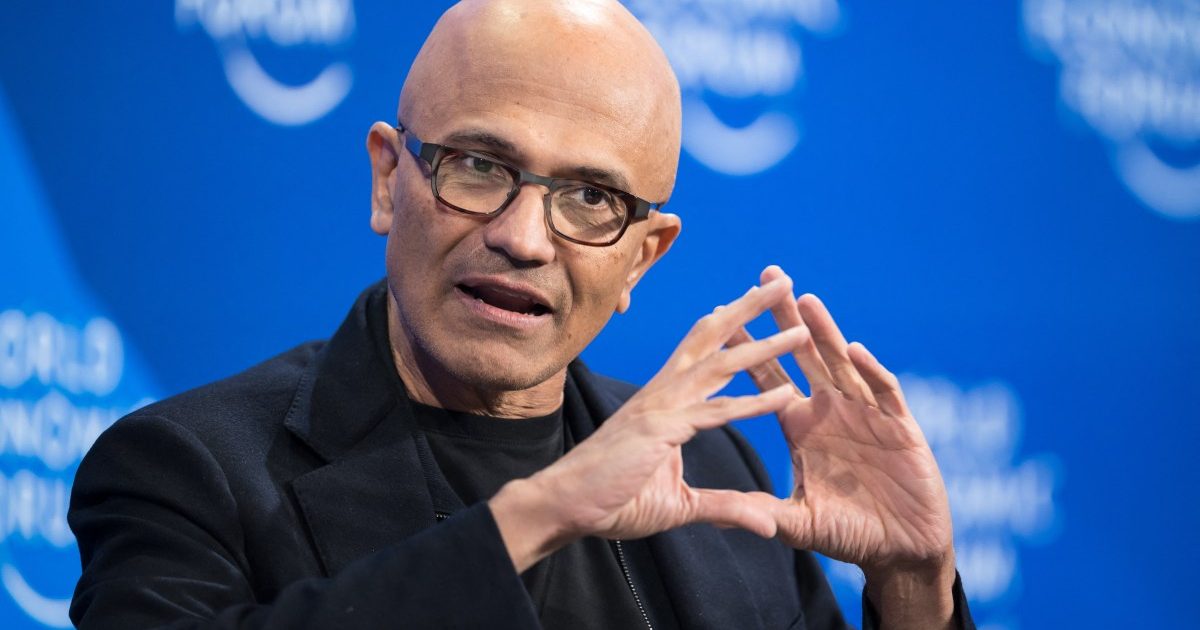
Microsoft Enters Direct Competition Against OpenAI and Anthropic

Pangram Raises $9 Million to Detect AI-Generated Content

Encore AI تجمع 30 مليون دولار لبناء وكلاء ذكاء اصطناعي يتعلمون من مكالمات العملاء

Hint: The AI-Powered Home Management Assistant with Martha Stewart's Touch