Learn about the advantages of Wi-Fi 6E – it will make your connection faster than ever
 By Admin
Wi-Fi technology does not receive a lot of thanks and appreciation, even though we rely on it on a daily basis to accomplish our tasks. Most people do not know that there is a new Wi-Fi standard that was launched under the name Wi-Fi 6E. This technology may solve most of the problems of slow Wi-Fi that the user currently faces. What are the advantages of this standard and what are the new developments? This is what we will talk about in this article.
What exactly is WiFi 6E?
Wi-Fi 6E, also known as 802.11ax WiFi or AX WiFi for short, is the latest version of Wi-Fi technology currently in existence, following the release of Wi-Fi 6 by only one year. The WiFi 6 standard was adopted in 2019, and a new version - WiFi 6E - was adopted in 2020. This update to the standard is surprising, as the WiFi Alliance launches a new standard approximately every five years in the usual case.
The reason for this is that this standard does not contain radical developments in Wi-Fi technology. Rather, it is considered developments of previously existing capabilities, and despite the simplicity of the developments, their impact is very large. This is where the standard's name comes from, as the extra E stands for Extended, similar to Microsoft's naming of its operating systems 8 and 8.1.
What are the advantages of WiFi 6E?
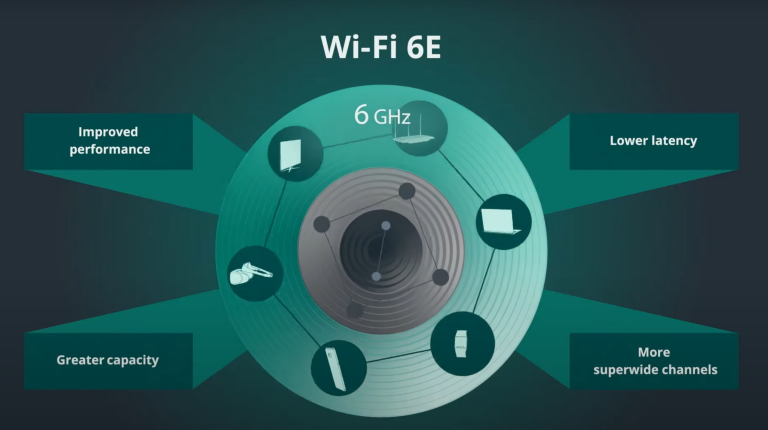
The most prominent advantages of Wi-Fi 6E were the availability of a frequency range of 6 GHz, in addition to 2.4 GHz and 5 GHz. If we want to be precise, the frequency of 6 GHz ranges between 5.925 GHz and 7.125 GHz. This addition allowed for an increase in the total bandwidth by 1.2 GHz compared to the previous standard, allowing multiple devices to transmit and receive on the same network without overlapping signals, which means faster and more reliable communication speeds. To explain it further, imagine that the total bandwidth of a network (the router in your home, for example) is the width of a street, and the data being uploaded or uploaded by you and other people on the network is the cars.
In the case of the 2.4 GHz frequency, there are only three non-overlapping sub-channels (let's consider them paths on the main street). This means that some transmission and reception operations have to wait for some time if there is pressure on the network. The matter does not stop with the users of your local network only, but also extends to the users of other neighboring networks on the same frequency (such as your neighbors), as some disturbance and interference occurs in the signals between the networks, which causes an increase in the delay in the signal (from the sender to the receiver or vice versa). This problem is the main cause of inconvenience for most users, as it is often the reason for interruption in video calls such as Zoom or high delay in the ping signal in your favorite online game.
The Wi-Fi 6E standard comes here to offer seven Ultrawide channels with a capacity of 160 MHz, to suit your applications and uses. Read also: How to reduce ping in online games It is possible for the maximum speed of Wi-Fi 6E to reach 1 gigabit per second, and the delay in the signal does not exceed one millisecond. Of course, this is assuming that your Internet provider can provide this speed, that the sending and receiving devices (your computer and mobile phone) support this standard, and that there are no problems hindering your signal (you can measure your Wi-Fi speed currently and make sure that there are no problems).
Do we really need this improvement? In fact, currently the answer depends on your use and situation. You may need the new standard for the purpose of reducing signal interference and data traffic congestion on the network in general, or for the purpose of increasing the capacity of the Internet speed, or perhaps to suit your use and applications such as frequent video meetings and playing video games on the Internet, especially VR and augmented reality games (AR), or because there are many devices that depend on the Internet in your home or workplace (IoT). All of the applications we mentioned previously require a highly reliable connection with great speed and little to no delay in the signal, in order to enjoy the ideal experience.
Having said that, if your use of the Internet does not exceed your use of social media and watching videos on YouTube, then you most likely will not need this technology and you will not feel much difference. However, I can say with full confidence that you will need it in the next ten years, because if you look at the current years, you will notice an increase in the use of all the technologies and applications I mentioned.
The bottom line is, you may not need it now, but you will have to
To be acquired in the coming years. Read also: The most important ways to strengthen the Wi-Fi signal at home. How do I know which Wi-Fi standard I am currently using? Most likely, your network is not currently using the Wi-Fi 6E standard, but rather Wi-Fi 4 or 5 at most.
Although the standard was launched in 2020, most router manufacturers do not manufacture their equipment based on this standard yet. In addition, all countries of the world have not adopted the standard, as some countries have not yet approved it (countries that support Wifi 6e). The previous map shows the countries that have adopted or are considering adopting the Wi-Fi 6 and 6E standards.
The dark green color symbolizes the country's adoption of the Wi-Fi 6E standard, while the light color symbolizes the possibility of adoption soon, and the dark red color symbolizes the adoption of the Wi-Fi 6 standard, and the light color symbolizes the possibility of adoption soon. If you are curious and want to know which Wi-Fi standard you are currently using, all you have to do is look at the network properties on your computer. First, click on the network you are connected to via the Start bar, and then click “Properties.”
The settings window will appear. Go to the end of the page and you will find all the details related to your network, such as the Wi-Fi standard, the maximum transfer speed, in addition to the number of channels, the security standard, etc. In conclusion, although Wi-Fi 6 and 6E may not be available in your country, the need for faster speeds and more reliable connectivity will push all manufacturers and countries to adopt these standards. It should be noted here that the next Wi-Fi standard is under development, and will be launched in 2024 under the name Wi-Fi 7!
DROPIDEA
We hope this article has added real value to you. At DROPIDEA, we always strive to deliver high-quality content that helps you grow and evolve in the digital space. Follow us for more useful articles and guides.
Admin
DROPIDEA
Latest Articles
Microsoft Gains $3.2 Billion from Its Investment in Anthropic

Zuckerberg: Billions of People Will Have AI Assistants Within Five Years

Microsoft Enters Direct Competition Against OpenAI and Anthropic

Pangram Raises $9 Million to Detect AI-Generated Content