Contents of the topic Toggle A detailed article on the challenges of e-marketing for the year 2014 The first challenge #1: The instability of Google and your market The second challenge #2: You cannot get a complete picture without (drilling) deep research The third challenge #3: Walking blindfolded The fourth challenge #4: Constant changes in the SERPs (search engine results pages) The fifth challenge #5: Traditional SEO is barely enough The sixth challenge #6: Quick fixes may get you into trouble A detailed article on the challenges of e-marketing for the year 2014 Not much of the year left.
Businesses that haven't started planning their marketing strategy and budgeting for 2014 should start soon. When it comes to online marketing, most businesses overly rely on web analytics. What they find in these analyzes affects future decisions about how and where we should invest time and money. Even drastic decisions like firing employees, changing the company's SEO staff, or taking other similar steps are based on these statistics.
As we are responsible for improving search results in companies, we are required to submit a report on improving work and results. Our evaluation is based on KPI (Key Performance Indicators) and these indicators are mostly the growth of organic traffic (coming organically from search engines) and visits that convert to sales from those searches.
Traffic Sources -> Sources -> Search -> Organic ( Visitor Sources -> Sources -> Search -> Organic ) in Google Analytics!! Unfortunately, I am wrong...but if you (like most search engine optimization developers) rely on your performance report: Why?
Because that data doesn't tell the whole story. Like cracks on an iceberg camouflaged by snow, there are serious holes in your Analytics data. If you don't know about them, you could fall into one of them – and that could lead to making incorrect or ineffective decisions.
The most common mistakes you can make: It can stop very effective tactics. You may be investing money, time and resources in less effective strategies.
You may slow the growth rate by taking a more difficult route. That is why it was very important to talk about this topic and present the most important challenges that you will face in the new year, especially for online marketers, as well as marketing officials in companies, and we will begin by explaining the 6 challenges that you will face in the field of SEO for the year 2014. Challenge #1: The instability of Google and your market. Most of my clients want to gain market share, traffic and results.
They forget that they first have to defend last year's results and the traffic they got!! You “do not own” your ranking on search engines or the traffic that comes from it.
Everything changes dynamically. Other businesses (i.e. your competitors) are constantly trying to steal your traffic, sales, and market share. At all times, you must adapt to the ever-changing environment around you in matters related to (- emerging technologies, Google algorithms and updates, behavioral changes in markets, new applications and devices, etc.) If your website achieved good results and got a flood of visitors last world (or earlier this year), this does not automatically mean that this improvement will continue into the next year. Without a plan to defend the previous results and develop a strategy to fight day and night against your competitors, you cannot expect it to continue. In seeing upward trends in Google Analytics – or earnings curves that are moving in a positive direction.
The message is clear: You need to allocate money and resources in your 2014 budget to champion your exposure, traffic, conversions and sales. The competition is intense and getting fiercer day by day, so you must be careful. Companies without a defensive strategy can lose – and perhaps even go bankrupt.
“Business as usual” is a losing approach. Foresight and good judgment are very important. SEO is not “click and install.” You cannot leave things “as is.” It is an ongoing process and requires constant updating.
Search engine optimization (SEO) strategies are constantly changing. Last year's methods may not work. Your techniques may need fine-tuning or even a total makeover.
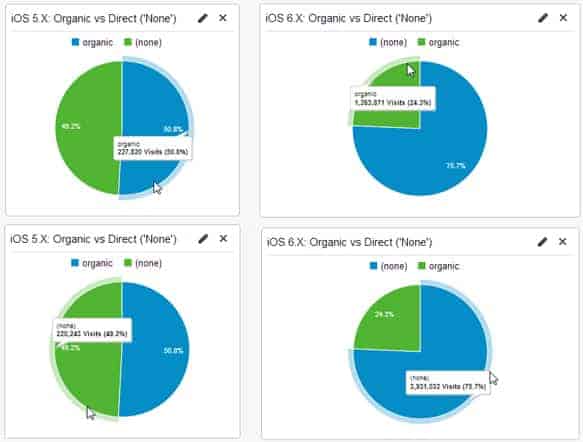
Challenge #2: You can't get a complete picture without digging deep When it comes to data and analytics, what you see isn't always what you get. For example, in the ISO 6 case, when Apple provided an update to its system that was unexpected by Google, people who arrived at your site via the Google search engine through the Safari browser were counted as direct visitors and not coming via organic (organic) search, which led some companies to change some of their business strategies, especially those that rely on mobile devices. This issue was later resolved (to some extent, at least), but this fix was not perfect – nor is it retroactive.
Based on this, we build that when analysts review the data for the entire year, there will be contradictions that cannot be easily reconciled. If you are not aware of this issue, it may seem to you that your SEO efforts are no longer effective!! If you measure your SEO success using traffic data from your web analytics platform, this misrepresentation of organic traffic (organic traffic coming from Google) can be costly and risky. For this reason, you, as a search engine optimizer, must account for such variables when analyzing data and creating reports.
Solution : Google Analytics Google Analytics allows you to create a list to compare direct and upcoming visits by search, and these statistics are available in iOS 6 and iOS 5. Here is an image from inside the free Google Analytics tool: Challenge #3: Walking blindfolded Less than two years ago, Google Search began encrypting the search terms of registered users (for privacy), preventing publishers from seeing the data that led to the referral of searches to those users in Google Analytics (and other web analysis platforms). While this step by Google, SEO experts expected that it was in “complete darkness” that the data extracted from search terms represents number one in the process of analyzing sites and developing some development plans based on them, some sites witnessed “more than 50% of these blocking cases.” You cannot see if you are blindfolded.
When users log in and search on Google, you can't tell what keywords were used to find your business. In Google Analytics, this huge amount of data is displayed under the label, “Not Provided” “Not Available.” Watch the following image: What can we do about it? Well, there's not much to do.
What you need to be aware of, is to accept that it is now difficult for you to know what keywords (generic or private brand) brought search traffic to your website. Challenge #4: Constant Changes to SERPs (Search Engine Results Pages) Search Engine Results Pages (SERPs) have changed a lot. Google is aggressively promoting vertical/global search, or in other words the knowledge graph and placing its own products above organic search results which are pushed further down.
Even with #3 for some keywords, I saw a disastrous drop in organic search traffic. This is for several reasons: On a 768-1024 pixel screen, the user must scroll to see their menus. Customers have to compete against many sites.
There are many related elements that attract attention and clicks. Well, if your growth rate is constant, what should you do? Don't blame yourself.
Don't fire your SEO people. So do not reduce your spending rate. Even if your site has grown a little this year, you haven't failed.
Just keeping traffic moving amidst all these changes is an amazing accomplishment. Be realistic in your expectations. It's harder than ever (to predict the future).
Challenge #5: Traditional SEO is barely enough SERPs are not consistent. In fact, they vary depending on the user's region. Mobile search is spreading incredibly fast.
Google knows which country/region a user is coming to your site from, and Google presents them with locally relevant suggestions so that makes a difference in search results. When searching for hotels when I was in Oslo, Google presented a list of local Norwegian hotels. If you don't rank high on the SERPs, your competitors will certainly be gaining sales while you're losing those sales.
Signals provided via social networks are included in the mix. What customers say about you and your business on social networks gives more weight than on-page SEO elements. Customer reviews are more important than ever.
Adapting to this new reality is important in your SEO efforts. In 2014, your geographic search strategy should be targeted and multifaceted. You need an international/global SEO strategy, as well as a national/country-level SEO strategy, and a local/city-level SEO strategy.
Get your business listed on local search results primarily. Here are some of the contributing factors to local rankings (yes, there's more to that than just titles and meta tags). Benefit from customer testimonials. If you have not used this before, you should use it today. Allocating a place for customer testimonials is very important.
Challenge #6: Quick Fixes Can Get You in Trouble “Band-Aid” SEO tactics are becoming less effective, and downright dangerous.
It may lead to your sites being banned and prosecuted by Google!
Attempting quick repairs should be done at your own risk. It is considered safer and more effective to follow
SEO best practices to win in the long term.
As you can see, there are a lot of challenges in SEO for 2014. That's why it's important to delve deeply into analyzing the results so that you know if you're looking at the right data before planning and budgeting for the coming year. Unless you are aware of these pitfalls, and you still have the option of diligently digging deep into your data, there is a good chance you will see everything you need to make sound decisions.
If you have any tips or suggestions for doing this better, or if you've dealt with similar issues in your own business or consulting work, please share your experiences with us. How do you analyze your Analytics data?
What did you discover that was helpful?
How can you track more organic search results? I know that in the Arab world it is difficult to get people who are actually interested in such posts, but I will continue writing them in the hope of getting interaction from you that will lead us to improve the image of the web and Arab companies in the world, with God’s help. Do not hesitate to share this article with your friends, as one of them may need it and also to help us deliver this article to the largest possible number of people.
My best regards to you. Follow the source:
6 SEO Challenges Every Business Owner & Marketer Must Contend With In 2014 #Internet Marketing #Electronic Marketing #Electronic Marketing Challenges #Internet Marketing Strategies #Electronic Marketing Tactics
DROPIDEA
We hope this article has added real value to you. At DROPIDEA, we always strive to deliver high-quality content that helps you grow and evolve in the digital space. Follow us for more useful articles and guides.

Admin
DROPIDEA
Latest Articles

Microsoft Gains $3.2 Billion from Its Investment in Anthropic

Zuckerberg: Billions of People Will Have AI Assistants Within Five Years

Microsoft Enters Direct Competition Against OpenAI and Anthropic

Pangram Raises $9 Million to Detect AI-Generated Content