Drones and cinematography: benefits and challenges of using aerial technology
 By Admin
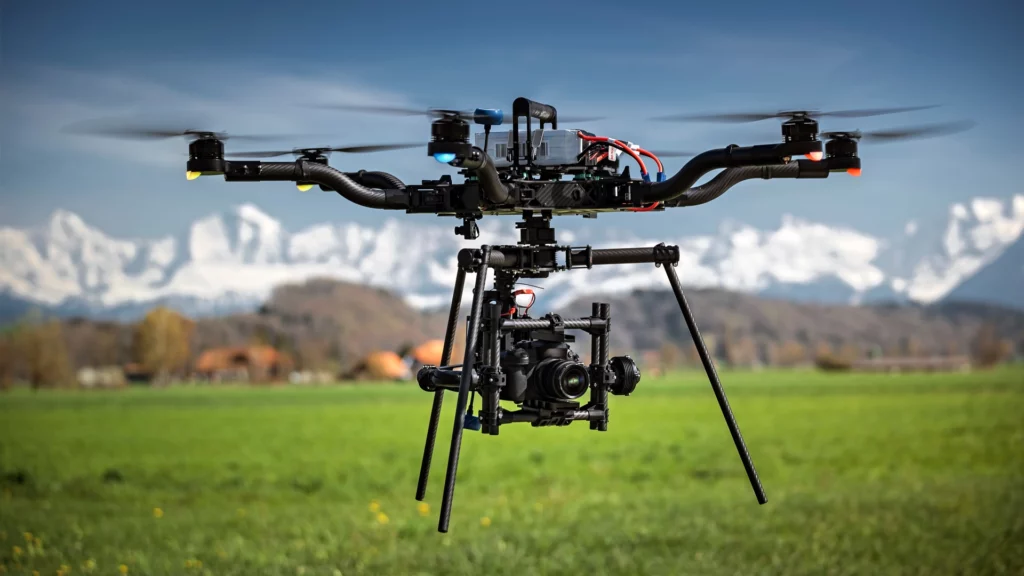
Drones have gained increasing popularity in the world of filmmaking and cinematography in the past ten years, giving filmmakers of all levels the ability to capture aerial footage that was otherwise impossible or very expensive to obtain. The use of drones in filmmaking has provided many professional and artistic benefits, but their use poses some challenges that filmmakers must take into consideration in order to use this technology effectively. Why Drone? One of the main benefits of using drones in cinematography is the ability to capture shots from a very wide range of angles. Filmmakers can easily capture sweeping aerial shots that provide a unique perspective on the action. It can add visual interest, artistic depth, and dramatic spirit to the artistic material, especially since we, as humans, are not accustomed to the perspective that drones can provide in ordinary life. Therefore, aerial shots provide us with a new viewing experience from new angles. And a different perspective.
In addition, drones in cinematography provide the ability to capture shots in locations that are difficult or impossible to reach using traditional photography equipment such as cranes, cranes, and other equipment. Drones are small in size and light in weight, which makes it easy to transport them to remote locations, allowing shots to be captured in areas that may be inaccessible or unsafe with a larger crew and equipment. Drones also provide the necessary technologies to ensure filming in the safest, smoothest and most stable way possible, without being significantly affected by external factors or by the varying experience of the operator or pilot who controls them behind the control device. This includes GPS, Vision Positioning Systems (VPS), motion stabilizers and special sensors to avoid collisions with obstacles and automatically avoid them or alert them. In addition to all of that, the camera (be it the main camera on the drone, or the special camera that we added to the drone) rests on a special motion stabilizer that stabilizes the movement on three axes, including the horizontal and vertical tilt axis and the rotation axis, which contributes to achieving a complex and distinctive pattern of camera movement, especially when applied with the movement of the aircraft/drone itself.
However, the use of drones in cinematography also presents some challenges. One of the biggest challenges is the need to obtain appropriate permission and authorization to fly a drone in certain locations. In many cases, this requires obtaining permission from local authorities and obtaining certain certificates and licensing papers before allowing the owner of the drone to use it within the country in which it is located. Another challenge to using drones in cinematography is the possibility of technical difficulties. Drones are complex devices of technology, and can be subject to technical problems such as battery failure, loss of signal after a certain height or distance, camera malfunction, and the drone being affected by a strong air current. All of what we mentioned can lead to losing the desired shots and delaying the production process, which can be frustrating for filmmakers and costly in terms of artistic production. Despite these challenges, the use of drones in cinematography continues to grow, and the search for innovative ways to integrate this technology into artistic works is still ongoing as drones have become more advanced and easier to use and acquire, which means that the scope of their use in the field of filmmaking is expanding, providing new possibilities for more literal visual storytelling.
Read also: Working with drones - Eric Austin How drones changed the field of filmmaking Before the idea of drones existed and before this tool was available to photographers around the world with the ease we live in today, there was only one way to shoot aerial shots, as the options lay in installing the camera within a gyroscope on board a glider/jet, or on a special helicopter whose pilot had special skills that allowed him to perform dangerous maneuvers to reach the desired shots. This method is still used today, of course, but as it is considered more expensive and more dangerous, it has become limited to large projects and large complex shots, while the presence of drones has contributed to reducing the cost from millions to a few hundred dollars to achieve simple shots, as a helicopter can cost between 500 thousand dollars, to millions of dollars, while we can obtain simpler and less expensive shots for an amount ranging from $1,200 to $8,000, and sometimes less! And here we can observe the method. In which drones changed the world of filmmaking and cinematography. Excess of what is available without need = decrease From time to time, some new technologies spread in the world of filmmaking, and some people rush to acquire these technologies, whether they are in lighting, such as RGB lighting, or in motion stabilization techniques, for example, or in investing in purchasing a drone, and this matter is good technically and professionally, but there is a point that I would like to highlight in this article, which is the necessity of answering the question: Why do we use the technology we have?
Is it because it is simply available to us? Or because the project and story we are working on require us to use this technology? In a previous article, we talked about the same point with regard to the use of RGB lighting, and how the use of this lighting has become greatly exaggerated, as it has become used in an unjustified excessive manner, without adding any aesthetics, feasibility, or artistic spirit to the project. Likewise, the matter relates to our topic today, as it is not necessary to use drones in every project just because we have that tool, but rather we must use it when we need it according to the project we are working on. Thus, we have produced creative artistic material with the appropriate tools for it, not produced material. Artistic with the equipment available at the expense of the story.
I hope that this article is sufficiently comprehensive. I would like to remind you that if you find any questions, you can send your inquiries by clicking on Contact Us, and you can also follow us through our account at
For more content. May you always be creative.
Did you like the article?
Share it with your friends..
DROPIDEA
We hope this article has added real value to you. At DROPIDEA, we always strive to deliver high-quality content that helps you grow and evolve in the digital space. Follow us for more useful articles and guides.
Admin
DROPIDEA
Latest Articles

Microsoft Gains $3.2 Billion from Its Investment in Anthropic
Zuckerberg: Billions of People Will Have AI Assistants Within Five Years
Microsoft Enters Direct Competition Against OpenAI and Anthropic
Pangram Raises $9 Million to Detect AI-Generated Content